The world is becoming increasingly conversational, and GenAI is helping people navigate a progressively complex world. In the world of entertainment, TV viewers are using voice search to cut through the congestion of the expanding video landscape, which continues to fragment across channels and services.
Despite the prevalence of voice functionality across devices, however, the usefulness of this technology hinges on data—real-world, real-time information that an LLM1 use to validate, inform and correct the responses it provides to user queries. Across the streaming landscape, this is especially critical for episodic content.

Not only does the amount of episodic content dwarf the number of movies available, audiences search for TV episodes differently than they search for movies. Viewers rarely know the specific season or episode they want to watch, especially in cases where a show has been around as long as mainstays like NCIS, Grey’s Anatomy and The Simpsons. So, when they search, they use contextual queries like “Show me the Christmas episodes of The Office” and “Which episodes of Friends feature Bruce Willis as a guest star?”
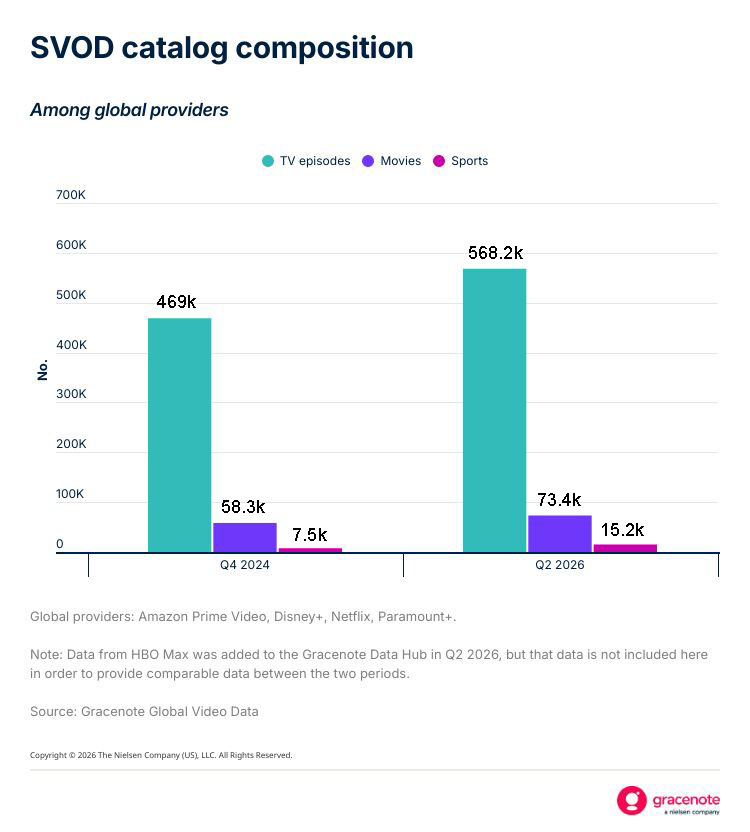
In these instances, LLM responses will usually be incorrect. That’s because they base their responses on probability using season and episode numbers. For providers, the poor user experience associated with incorrect responses will compound frustrations over growing content fragmentation. Episodic content plays a big role in content congestion, as TV episodes account for 85% of the content distributed by the six global SVOD providers tracked in the Gracenote Data Hub.
As video catalogs grow, GenAI will become increasingly helpful to viewers looking for something to watch. In just a year-and-a-half, for example, the amount of TV episodes available to audiences has increased by more than 21%.
By offering features like conversational search, personalized program imagery, tailored recommendations and real-time sports highlights, GenAI will transform how viewers engage with video content.
To offer these capabilities—and deliver them in ways that are relevant and personalized—the LLMs that power search and discovery need access to accurate and comprehensive entertainment data. This is especially true for the 50% of Americans who say they would consider canceling a service if it doesn’t provide content of interest to them2.
The connection to validated, real-time data is critical, as the LLMs that are deployed for enterprise use aren’t grounded with any external information sources. Unlike popular chatbots (e.g., ChatGPT, Gemini), they only know what their training data provides. Here, information about new programs often falls outside of an LLM’s training data, leaving them without the ability to help viewers find what they’re looking for. The Steve Carell-led comedy Rooster, for example, is too new for an LLM released in 2025 to have any information about.
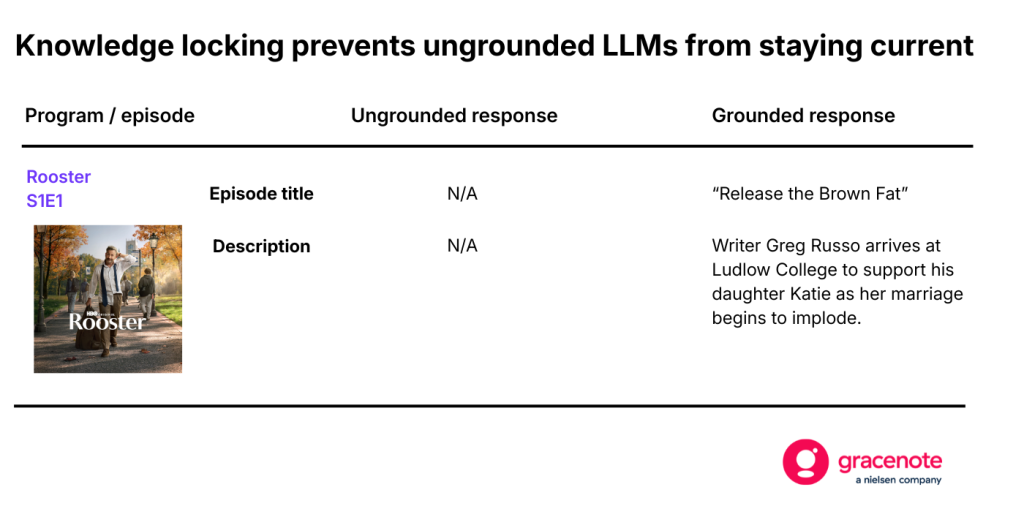
Ungrounded LLM responses and the viewer experience
As detailed in our recent Plot holes in AI report, ungrounded LLMs struggle to provide accurate responses when asked about basic attributes in popular TV shows and movies. When it comes to episodic content, this shortcoming is far more pronounced. That’s because metadata attributes are far more unique at the episode level than they are at the program title level.
Semantic guessing, predictive probability and a lack of indexing capabilities all contribute to a much higher likelihood that an ungrounded LLM will hallucinate when all they have to work with is a program title, a season number and an episode number. And importantly, viewers rarely search for an episode using its title.
To better understand the importance of grounding in search and discovery at the episode level, we recently assessed the quality of ungrounded LLM responses to basic questions about specific TV episodes. While people don’t search this way, we used season and episode numbers in our queries to evaluate the accuracy of the corresponding metadata. The study included 100 popular episodes from 13 countries (1,300 in total).
In aggregate, the factual accuracy of the responses for episodes was significantly lower than it was for TV shows and movies. Among the 100 top episodes in the U.S., for example, only 27% of the program descriptions, on average, was accurate2, compared with an average of 69% of the descriptions for the top 100 TV shows and 100 movies.
Accuracy wasn’t the only attribute the ungrounded LLM struggled with across the 1,300 episodes (100 per country) in the study. Having information was an even bigger problem, as it didn’t have any information (title, description, actors, genre) for 604 of the episodes (46.5% of the total). This was most evident in Sweden, where no information was provided for 73 of the 100 episodes. In the U.S., the ungrounded LLM provided no information for 31 episodes.
The one with the wrong storyline
When the ungrounded LLM wasn’t returning empty responses, it was frequently providing incorrect episode descriptions—a byproduct of semantic guessing, predictive probability and a lack of indexing. While viewers would likely never search for an episode using only a series number and an episode, streaming services use these attributes to convert resultant episode titles into deep links or an associated record in their data lake. Here, backend data harmonization and indexing is critical in ensuring that a service can accurately return the right content for each individual viewer.
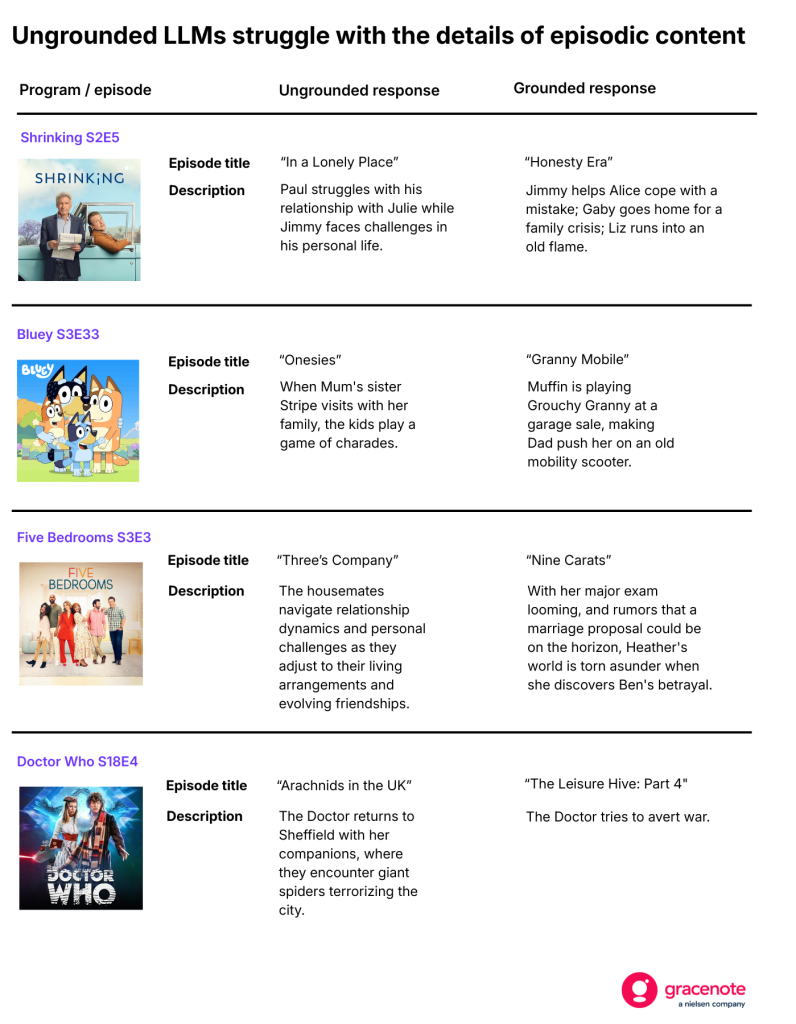
With only a series number and an episode number in each query, the ungrounded LLM frequently provided descriptions that outlined the details of entirely different episodes than the ones being asked about. In the examples below, the titles and descriptions provided by the ungrounded LLM are incorrect.
Grounding is critical for next-gen content experiences
The way consumers search for information and the tools they use are changing. GenAI usage is a mainstay among digital natives, and adoption is broadening quickly.
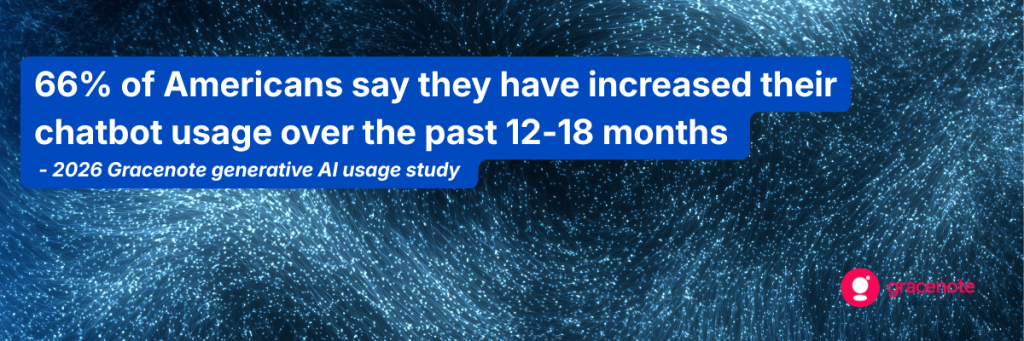
Today’s content landscape is too vast to navigate with legacy search functions—even within individual platforms and services. The use of GenAI for content search and discovery represents a tectonic shift in user experience that has the potential to greatly reduce negative viewer sentiment as content congestion expands.
But when asked about S02E06 from Stranger Things, the ungrounded LLM’s response combined information from several different episodes. Here, a viewer will ultimately come to distrust the service, which is already common among current chatbot users: 75% say they verify the results AI chatbots provide because they worry they are incorrect3.
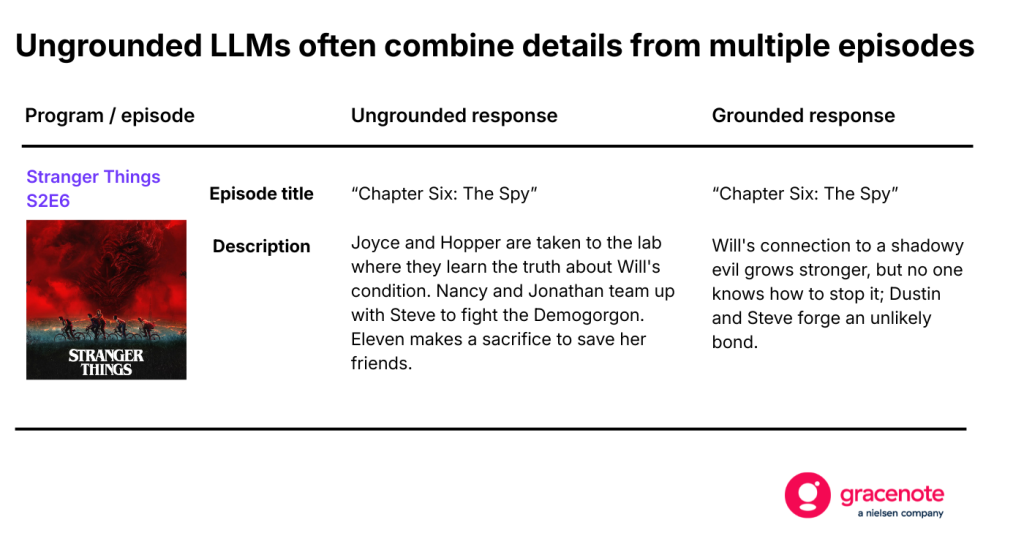
The end result in this scenario is a poor user experience—one that could cause the viewer to look elsewhere for something to watch.
For additional insights regarding the use of ungrounded LLMs in content search and discovery experiences, download our Plot holes in AI report.
Notes
- LLMs are a type of generative AI that are trained on massive amounts of data to understand and generate human-like language.
- When compared against the grounding data.
- Gracenote 2026 GenAI usage study
The cost of fragmentation: Discovery challenges are pushing sports fans to highlights
Discovery is a bigger hurdle for sports fans than subscription cost.
Solving sports churn: the home screen advantage in modern streaming
Centralizing everything that fans are looking for can reduce churn and foster long-term engagement.
Home screen advantage
Centralized sports hubs could be game changing for content providers.