In addition to transforming how we watch television, streaming has transformed what we watch. Not only has it put audiences in control of their TV schedules, it has opened the doors to a wealth of global content that traditional, local distribution TV could never offer. And perhaps more importantly, audiences are voting for this variety with their remotes.
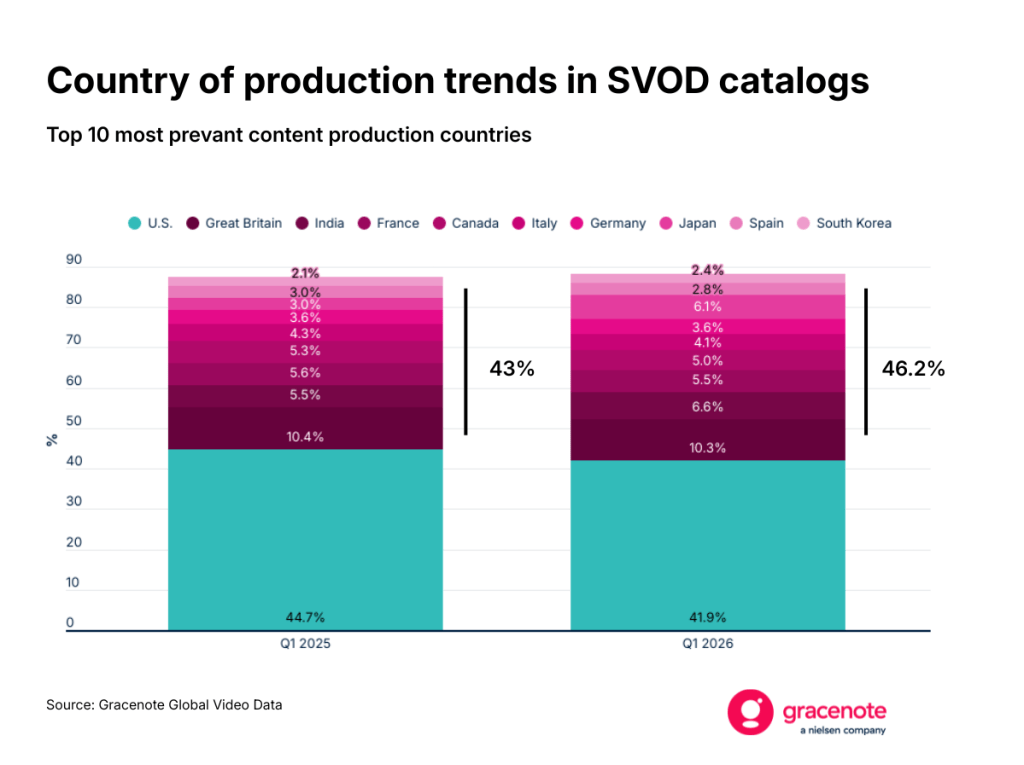
Now the dominant TV option for audiences in the U.S.1, streaming has become notably international in scope. Despite their roots in the U.S., for example, the five global SVOD services tracked in the Gracenote Data Hub offer more global content than U.S. content: Only 42% of the programming they distribute was produced in the U.S., down from 45% year-over-year. Combined, content from nine other countries now accounts for more of the total distribution than the U.S. does.
The great content diversification
While all providers have an array of content from countries around the world, Netflix and Amazon Prime Video offer the most, as only 31.9% and 41.9% of their catalogs comprise U.S. content, respectively. And perhaps more noteworthy is the fact that both of these percentages are down year-over-year (from 32.4% and 45.2%, respectively).
Geographic trends notwithstanding, U.S. content production is not slowing down. In Q1 2026, TV audiences for these five services have 13% more U.S. content to choose from across TV shows, sports programs and movies than they did a year ago. The reduced overall concentration of U.S. content reflects a significant ramp-up in content from other countries, most notably Japan and South Korea.
Content from Japan now accounts for more than 6% of all content across global SVOD providers
Across countries, Japan has fueled the biggest rise in available content on global SVOD providers, accounting for 6.1% of all content, up from 3% a year ago. Netflix has the greatest concentration of Japanese content, rising to 9.5% from 6.5% a year ago. Amazon Prime Video, however, added more than 3,600 Japanese titles over the past year, the most of any provider. Given Amazon Prime Video’s massive catalog, however, Japanese content represents just 6.1% of the total.
India is also a major factor in this evolution. Content from India now accounts for 6.6% of global SVOD libraries, up from 5.5% last year. Amazon Prime Video, in particular, has dramatically increased its investment in Indian storytelling, adding 60% more titles to its library in the past year alone.
Global content feeds viewer appetites
This shift isn’t just about filling library space; it’s about narrative diversity. Geographically diverse content brings a fresh range of storytelling techniques and social dynamics that resonate with a globalized audience.
They’re also driving big viewing numbers.
Throughout 2025, Nielsen’s Top 10 lists regularly featured at least one original show from outside the U.S. From the Australian powerhouse Bluey (the most-streamed program for two years running) to European hits like Cassandra (Germany) and The Glass Dome (Sweden), the appetite for international perspectives is voracious.
As the CTV landscape continues to mature, the “home” of a production matters less than the quality of the story. We’ve entered an era of “culture-rich” abundance, where a viewer in New York is just as likely to be captivated by a thriller from Argentina as a sitcom from Hollywood.
And to feed those appetites, some of the biggest names in streaming video are bringing geographically diverse content front and center. The effect is an abundance of narrative diversity, ripe with a range of storytelling techniques and diverse social dynamics.
For additional insights, visit the Gracenote Data Hub.
Note
- In January 2026, streaming accounted for 47% of total TV usage, more than cable and broadcast combined: Nielsen’s The Gauge.
Streamers and indies are redefining the Academy Award landscape
This year, across all categories, Netflix, Apple, A24 and NEON have secured a total of 53 nominations across 17 films.
Sports programming grew its footprint across the streaming landscape in 2025
While content libraries grow and distribution channels multiply, sports have become the hottest commodity across the streaming landscape.
How RAG and MCP differ in powering AI-driven TV experiences
RAG and MCP each address the limitations of LLMs, but they approach the issue in fundamentally different ways.