
By Tyler Bell, SVP Product
Looking for something good to watch? So am I. Let me know when you find it.
More than a decade into the world of on-demand TV bliss, viewers have never had it so good. Streaming, in all of its iterations, has become second nature. In the U.S., the biggest streaming market in the world, viewers have spent 45% or more of their total TV time with streaming services since June1, and more than one-in-five subscribe to six or more services to feed their growing CTV appetites2.
To satiate those appetites, content sources proliferate, and their catalogs are perpetually growing. The result? More content than any of us could ever think of watching in a single lifetime.
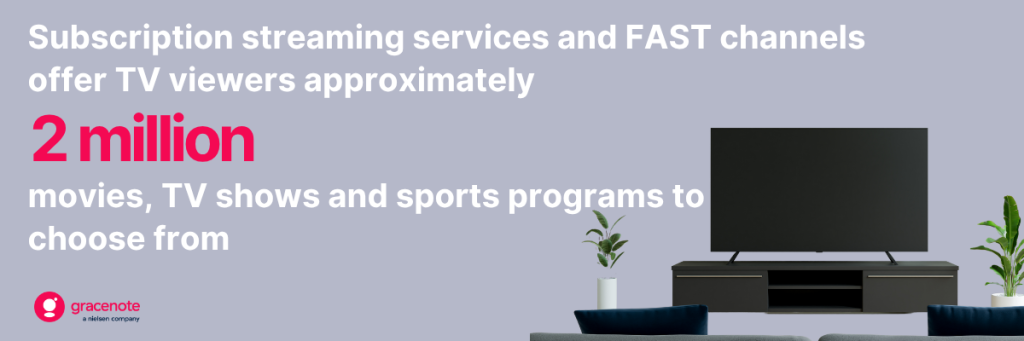
With this breadth of choice at viewers’ fingertips, it’s no surprise that three-fourths2 say they love their streaming experiences.
But here’s the rub: Those same viewers have become overwhelmed by choice and fragmentation. This sentiment is mounting, and it has a range of downstream effects.
Viewers:
- Spend more time searching for something to watch
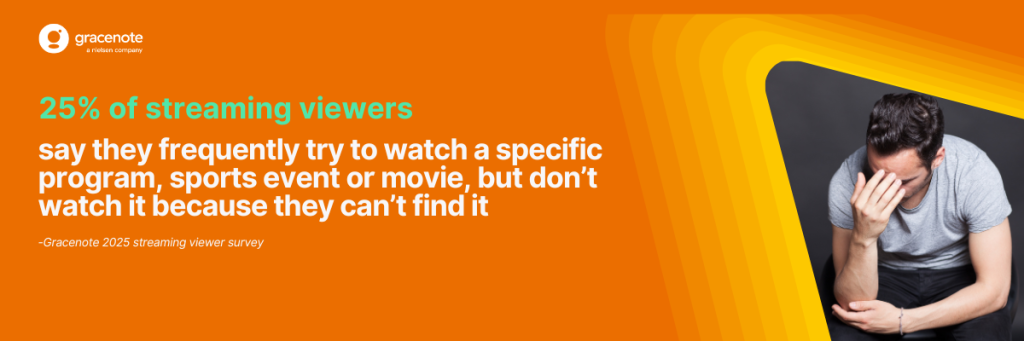
- Know what they want to watch but still can’t find it
- Cancel services that don’t offer the right content
- Open trial subscriptions and cancel them after watching the one thing they signed up to watch
- Abandon their content searches and do something else altogether
The aggregation of this list of individual pain points, however, amounts to a much larger problem: a negative TV experience.
It may sound extreme, but one-third of streaming viewers who participated in a recent Gracenote survey said just that: the number of streaming services and the content they offer has a negative impact on their overall enjoyment of TV. The percentage is notably higher among viewers in France, the U.K. and viewers aged 18-34.
What’s often overlooked is that these frustrations carry real business impact. Increased search time reduces session starts, which in turn, lowers ad impressions for AVOD and FAST publishers that rely on steady viewing to fill their ad loads. For SVOD services, poor discovery contributes directly to churn at a time when retention has become a quarter-by-quarter battle. And in sports, fragmented rights routinely complicate reach delivery, making national ad guarantees harder to meet and putting pressure on CPMs. What feels like a user-experience issue quickly becomes a revenue and margin issue across the board.
Additionally, increased choice has not generated more TV viewing. Outside of the early days of the COVID-19 lockdowns, the time we spend with TV has been steady for years. The only real change is the shift to CTV, which now accounts for more of our TV time than traditional, linear TV3. This shift is likely driven less by the over-the-top (OTT) delivery mechanism of streaming, and more to the convenience of watching TV on your schedule (VOD) rather than watching TV on someone else’s (linear).
Level TV engagement amid a rising tide of content options puts an increasing premium on any publisher’s ability to keep audiences engaged and fulfilled. The challenge today, however, is that audiences lack the guidance they need to find what they’re looking for, or a means to adhere the pieces of an increasingly fragmented viewing experience. This applies to people who don’t know what they want to watch as well as those who do. The latter is most evident with live sports, which have become frustratingly difficult to find as sports rights splinter across channels and services.
Amid rising costs, the increase in bundled services has helped MPVDs reduce churn, attract subscribers and offer a more cost-effective experience for customers. But they don’t address the issue of holistic content discovery. That’s because the services within bundles remain partitioned, with few satisfactory examples of an integrated user interface or unified content guide.
There is a fundamental tension in the market here: users want a holistic experience, while apps prioritize differentiation, captivation and retention. Put another way: platforms want to provide an overall view of the entertainment landscape, while apps are keen to ensure you view this same landscape through their specific lens. Both are not incorrect in their intentions, but the consumer pays the price by way of an inconsistent and fractured experience.
Look at how voice search is implemented on your preferred platform as a parallel but topical example: it’s unlikely that the microphone on your remote behaves uniformly on both the platform and within the app. Some implement a soft remote in app, while others have no voice search capability. This common discrepancy is due to the zero-sum approach of “owning” the voice UX and the concomitant value search query data provides.
Consumer use of voice search will only increase as CTV powers these experiences with AI (and large language models specifically), and therefore, we might expect the voice search UX to become even more inconsistent between apps and platforms. As with content, the current fragmentation and differentiation of the voice UX is a result of the tension between publishers and platforms, and the conflict between the convenience uniformity provides, and the commercial desire to differentiate services and captivate the viewer.
As much as they clamored for the freedom that comes with the on-demand streaming, audiences are now inundated with content with little overarching structure or implementation to point them to what they’re looking for. Today, an average of 46% of streaming viewers agree that the abundance of content and sources has made it challenging to find the content they want to watch, with just as many agreeing that they now feel overwhelmed as a result. Consequently, two-thirds say they want a single menu or guide that lists out everything in one interface. The percentage is notably higher among viewers in Brazil and the U.S.
From an individual brand perspective, it’s easy to understand why a collective menu or guide might not be desirable. That said, viewers aren’t looking for a program because it’s affiliated with a specific channel or service. They’re looking for it because it interests them. Yes, viewers associate the hit show Wednesday with Netflix, but that’s only because they know that’s the service that distributes it. Most programs, especially sports, don’t have that luxury.
This article originally appeared on The Streaming Wars.
Notes
- Nielsen’s The Gauge
- Gracenote 2025 streaming consumer survey
- In Q2 2025, time spent with CTV accounted for 49% of U.S. viewers’ time; time with live TV accounted for 45%; Nielsen Audience Insights Data (Nielsen NPOWER, Nielsen Media Impact)
Grounded thinking: Why AI-powered CTV experiences rise or fall on data
Bad data is a real threat. LLMs are powerful tools, but they are only as good as the information they can access.
Streamers and indies are redefining the Academy Award landscape
This year, across all categories, Netflix, Apple, A24 and NEON have secured a total of 53 nominations across 17 films.
Global SVOD services are delivering global content experiences
Despite their roots in the U.S., the five global SVOD services tracked in the Gracenote Data Hub offer more global content than U.S. content.