The cost of fragmentation: Discovery challenges are pushing sports fans to highlights

For sports fans, the growing abundance of sports content couldn’t be a bigger positive. As the lifeblood of live TV viewing, sports attract massive audiences, and those audiences are ravenous in their quests to keep up with all the action. Those quests, however, have become overbearing amid growing fragmentation.
Nearly 42% of fans ages 18-34 say they prefer watching highlights over live games
Given the appeal and draw of sports content, it’s not surprising that the broadcast rights for many league and team events are splintering across a growing array of channels and services. As a result, games and events are harder to find, and a growing portion of fans now prefer watching highlights over the live competitions. This is particularly true for younger fans.
Fans are willing to pay for sports content
While the pivot to watching highlights likely reflects more than just the difficulty in finding a specific game, data from Gracenote’s 2026 global fan survey suggests that discovery is a bigger factor than cost. Nearly 70% of all fans subscribe to a service for sports programming, and nearly 24% of those fans pay for three or more services for sports content. Perhaps more noteworthy is the fact that fans 18-34 — those who most prefer watching highlights — spend the most.
Among fans, discovery is a bigger hurdle than cost
Clean centralized metadata syndication would transform sports discovery into an automated supply chain. While some parties in the ecosystem are resistant to shared metadata for strategic and financial reasons, the current environment dilutes reach and weakens engagement — the opposite of what fans are seeking.
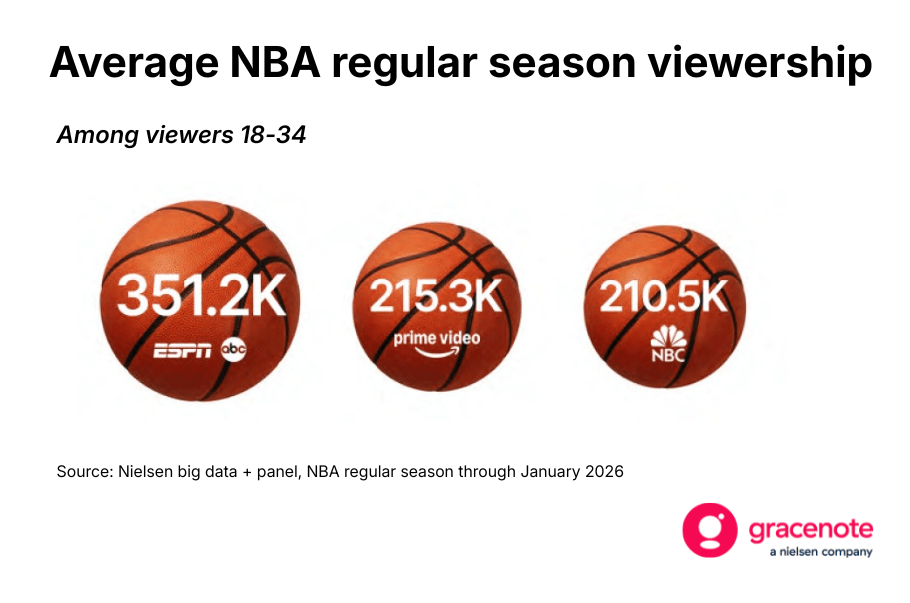
Scale is a factor here, both in terms of subscriber base and investment in sports rights. Amazon Prime Video, for example, broadcast 66 regular season NBA games in the 2025-26 season, resulting in viewership that rivaled traditional TV broadcasts.
Peacock, on the other hand, carried one exclusive NFL game in the 2025-26 season, and it attracted the smallest audience among streaming exclusives (9.7 million viewers).
From a fan perspective, the NFL is the biggest draw across leagues in the U.S., as just over 80% of fans say they watch NFL games, compared with the 70.4% who watch NBA games. Here, the lackluster viewership of a holiday NFL game — one that had playoff implications for both teams — could have been bolstered by greater discoverability.
That’s because fans are very inclined to take on new subscriptions that offer live sports: 50% say they would consider paying the cost of an additional service for the live sports it offers. Among fans 18-34, the percentage is nearly 70%. This willingness to spend more suggests that opting for highlights is more correlated with content discovery than cost.
The shift of sports to connected TV (CTV) is still relatively new, given that it wasn’t until mid 2024 that pure play streamers like Netflix and Amazon Prime Video began making monumental investments in sports. Not all publishers have invested as heavily, which complicates discovery for fans, especially when a channel or service only carries a game or two within a single season.
The dilution of reach is a negative for leagues, especially as global interest in sports rises. Publishers have incentives to wall off their individual experiences, but those may be hurting the benefits of greater discoverability — especially when many fans are willing to pay for an additional cost of entry.
For additional insights, download our 2026 sports report.
Solving sports churn: the home screen advantage in modern streaming
Centralizing everything that fans are looking for can reduce churn and foster long-term engagement.
Home screen advantage
Centralized sports hubs could be game changing for content providers.
Live sports and news are the new heavyweights on FAST channels
FAST audiences have 26.6% more news programs and 37.5% more sports programs to choose from than they did a year ago.