In our ongoing quest for information, search tools and behaviors are changing. Now integrated with traditional search engines, AI is providing something that a keyword-matching algorithm can’t: a conversational experience that’s personal and iterative.
In the realm of entertainment, however, most providers aren’t ready to deliver in the way that popular generative AI chatbots like ChatGPT and Gemini do. That’s because the large language models (LLMs1) that are licensed to businesses aren’t “grounded” with external, real-world knowledge sources.
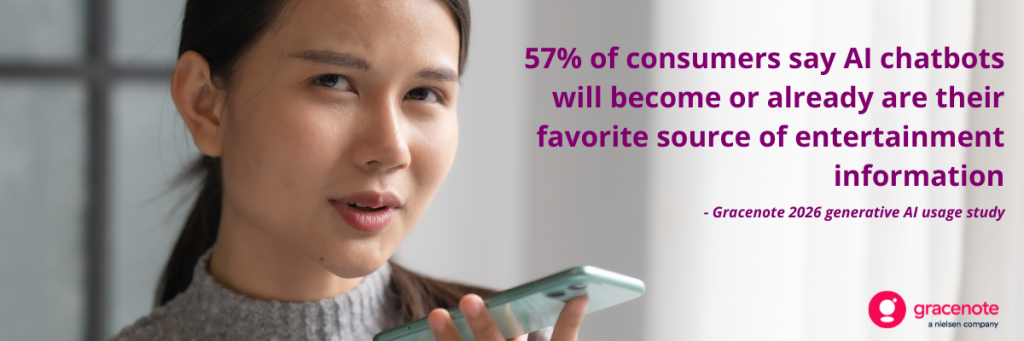
As a result of rapid AI adoption, there is an expectation gap among companies looking to leverage LLMs for their own business cases. In order for enterprise LLMs to provide the next-gen content experiences they have the ability to, however, access to trusted, industry-specific data is paramount.
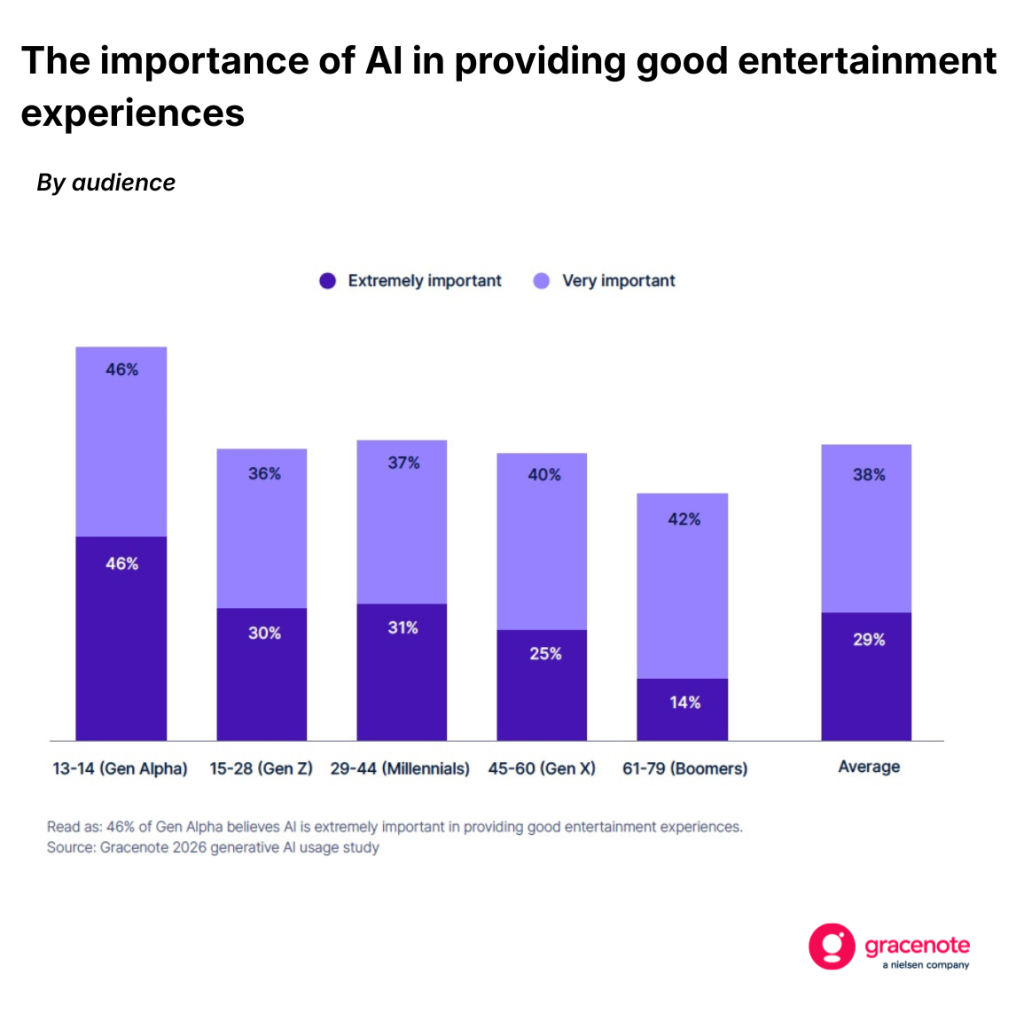
In the realm of content discovery, people already have high expectations for AI.
Solving content discovery in a fragmented TV landscape
LLMs bring novel capabilities and huge potential to the TV experience. They provide vastly improved search capabilities, for example, allowing viewers to ask incredibly sophisticated questions well beyond the limitations of traditional search. LLMs can also dynamically rewrite or augment the description of a movie or episode to make it more topical—even more geographically relevant—for individual users.

In specific industries, training and grounding data need to be far deeper than what the open internet can provide. In entertainment, consumer expectations, fueled by improving technology, are rising. Based on industry projections around OTT and pay TV spending2, content providers have a big incentive to fine-tune their individual value propositions.
At a time when 26% of Americans say they know what they want to watch and still can’t find it3, AI has the power to help. But here, even popular chatbots struggle. A 2025 Veed Analytics study into the use of chatbots for content discovery, for example, found that only two-thirds of the results from the tested chatbots4 were correct in identifying where to find a specific program. And, perhaps less satisfying from a user perspective, only 31% provided the deep link to the title of the program.

Through the lens of improved content discovery, LLMs offer three significant advantages over traditional databases and rudimentary search functions:
- Vastly improved semantic search capabilities
- Exhaustive and harmonized content catalogs
- Powerful ranking and sorting capabilities
Today’s content landscape is too vast to navigate with legacy search functions—even within individual platforms and services. The introduction of GenAI for content search and discovery will facilitate a tectonic shift in user experience that has the potential to greatly reduce unfavorable viewer sentiment as content congestion and fragmentation hamper overall TV enjoyment—but only if it delivers accurate results.
For more insights, download our TV search and discovery in the AI era report.
Notes
- LLMs are a type of generative AI that create content based on learned patterns.
- PwC projects that consumer spending on over-the-top (OTT3) services and pay TV will reach $318.5 billion in 2029.
- 2025 Gracenote streaming consumer survey.
- ChatGPT, Claude, Gemini, Perplexity
The cost of fragmentation: Discovery challenges are pushing sports fans to highlights
Discovery is a bigger hurdle for sports fans than subscription cost.
Solving sports churn: the home screen advantage in modern streaming
Centralizing everything that fans are looking for can reduce churn and foster long-term engagement.
Home screen advantage
Centralized sports hubs could be game changing for content providers.