In an era where sports fans often feel like they need a PhD in subscription management to follow their favorite teams, the broadcast schedule for this year’s FIFA Men’s World Cup (June 11-July 19) is comparatively straightforward and fragmentation free.
In the U.S., four traditional TV channels will carry all of the games: English telecasts will be on FOX and FS1, and Spanish telecasts will be on Telemundo and Universo. The traditional nature of this tournament’s TV schedule reflects FIFA’s renewal of the broadcast rights for this year’s tournament with Fox and NBCU back in 2015—a time when more people likely knew Netflix for its mailed DVD service than for its video streaming.
As sports rights continue migrating to streaming, however, future World Cup broadcasting schedules could look much different. Netflix, for example, has secured the U.S. and Canadian exclusive live broadcast rights for the 2027 and 2031 Women’s FIFA World Cups. The streamer, which has increased its sports programming by 9.3%1 over the past year, has also expressed interest in the rights for the 2030 Men’s World Cup.

Netflix isn’t alone in growing its portfolio of sports programming. All but one of the six global SVOD providers tracked in the Gracenote Data Hub have ramped up their sports content over the past year, with sports now accounting for 5% of the total content they distribute. Unlike the other providers, Disney+ has pulled back on sports distribution, reducing its sports catalog at the game and event level over the past year by 23.4%.
Centralized broadcasting is fading
This year’s 2026 World Cup will be massive, featuring 104 matches and 48 teams competing in 16 cities in Canada, Mexico and the U.S. Despite the scale and the stakes, the centralized broadcast experience in the U.S. and Canada (via TSN) will be fragmentation free for sports fans—an attribute that may change with future tournaments.
Distribution of the 2026 World Cup in South America provides some insight into what future strategies could look like. In addition to being carried by country-specific free-to-air broadcasters (e.g., Televen in Venezuela), ESPN, through the Disney+ Premium plan, will broadcast 30 matches from the tournament, including the final.
Anti-siphoning laws are a factor in many markets, which are designed to prevent pay TV and streaming services from monopolizing the broadcast rights to major, culturally significant events, including tentpole sports competitions. These laws vary by market, but they typically pertain to only the games that feature the home-market teams. Ireland’s World Cup matches, for example, need to be available to fans in Ireland on a qualifying broadcaster (RTÉ, Virgin Media TV, or TG4).
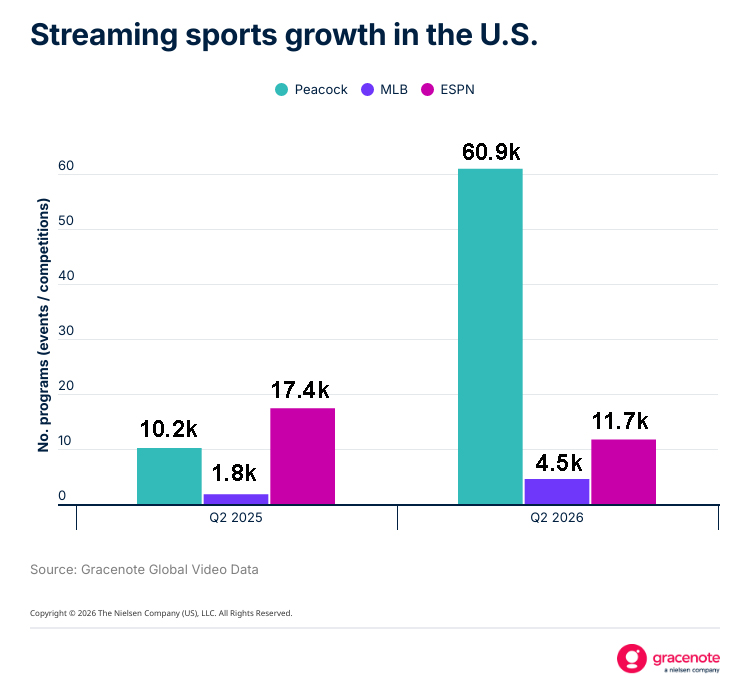
Outside of global events like the Olympics and the World Cup, however, CTV adoption continues to complicate content discovery for sports fans as streamers continue to bolster their sports catalogs. In the U.S., Peacock and MLB have dramatically increased their sports content over the past year, while ESPN’s streaming catalog is down 33%.
For the World Cup, streaming is the supportive second
While traditional networks will carry the live action of this year’s World Cup, streaming isn’t absent from the equation. Here, it’s supportive, as FIFA and its partners are leveraging digital platforms to expand reach and provide 24/7 engagement.
Free ad-supported streaming television (FAST) channels play a big role here. While part of the CTV and streaming landscape, FAST channels operate like traditional linear options, offering a familiar experience without the cord, or the cost. Tubi’s FIFA World Cup Fox Hub and Telemundo’s “Deportes Ahora” FAST channel, for example, will complement the live match action with an array of original content, highlights and related programming around the clock throughout the entire tournament.
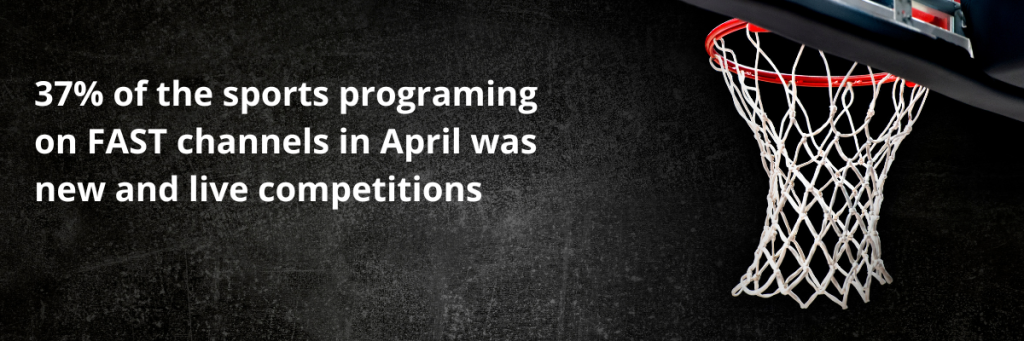
The availability of FIFA World Cup content on FAST channels is part of a much broader trend: sports is one of the fastest growing genres on FAST channels. As of April 2026, Gracenote tracked a total 258 sports channels across FAST, up 12.2% on a year-over-year basis. And since the start of 2025, sports programming on FAST channels, including individual games, has increased 18.5%.
In addition to offering streamlined access to live matches, the 2026 FIFA World Cup’s distribution strategy will play well in fan recruitment. Globally, soccer is the most popular sport, with 51% of people saying they’re fans2. In the U.S., however, only 27% identify as fans. The upside here is that 37% expect their interest to grow in the coming year, and straightforward access to the World Cup games will certainly help feed viewer appetites.
Two other factors will help drive viewership in the U.S. for this year’s World Cup: host location and participation of the U.S. team. These were primary reasons why viewership dipped in 2018 after a record high for the 2014 tournament.
Given the renewal of the U.S. broadcast rights for this year’s World Cup happened more than a decade ago, the centralized distribution strategy of this year’s World Cup games addresses some of the biggest friction points that TV viewers3 have with respect to the expanding TV landscape:
- 51% of Americans say it’s getting harder to find the video content they want to watch because there are too many services available.
- 53% of Americans say the amount of streaming services and content is overwhelming.
- 34% of Americans say the amount of services and content is having a negative impact on TV enjoyment.
With the 2026 World Cup, broadcasters will offer a wealth of content that’s contained in a small ecosystem that streamlines access and discovery, which has become somewhat of a rarity amid the proliferation of channels and services vying for lucrative sports rights.
Notes
- At the individual game/event level; Gracenote Global Video Data (April 2025-April 2026)
- Nielsen’s 2026 Tops of Sports report
The cost of fragmentation: Discovery challenges are pushing sports fans to highlights
Discovery is a bigger hurdle for sports fans than subscription cost.
Solving sports churn: the home screen advantage in modern streaming
Centralizing everything that fans are looking for can reduce churn and foster long-term engagement.
Home screen advantage
Centralized sports hubs could be game changing for content providers.