As a prime driver of appointment TV viewing, sports programming has become a critical fixture in the annual TV upfronts. Yet even as streaming becomes bundled in upfront deals, the broadening CTV landscape opens a wealth of advertising opportunity that sits well outside of national upfront deals.
Here’s an example:
The 2026 NCAA College Football Championship game was broadcast Jan. 19, 2026, across 167 national and local ESPN affiliates1. While this inventory was likely sold during well in advance of the game during the upfronts, the inventory that was broadcast across the more than 5,300 individual CTV distributors that carried the game was less likely to have been.
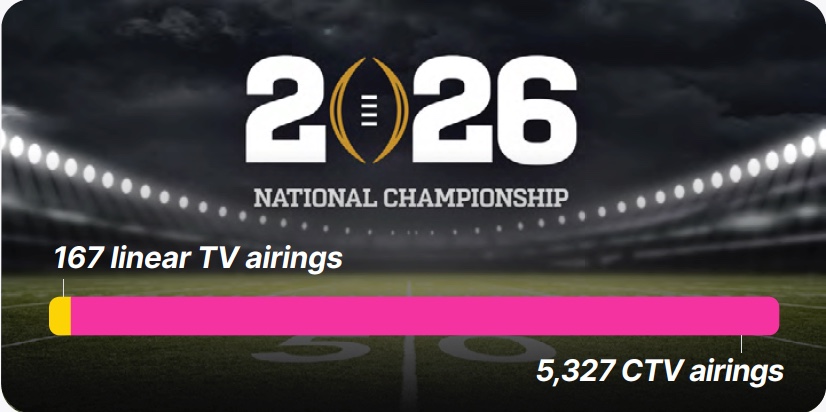
From an advertiser perspective, the game was massive, pulling in 30.1 million viewers, the biggest audience for a college football game since the inaugural CFP National Championship for the 2014-15 season.
Importantly, this massive audience was not confined to a single channel. It was dispersed across a very fragmented TV landscape, including the thousands of CTV distribution points, which included an array of vMVPD2 providers like DirecTV, Fubo, Sling and YouTube TV. This CTV fragmentation presents several challenges for advertisers looking to tap into the power of big sports events like these:
- Buying at scale for a single event requires knowledge of each and every distribution channel.
- The majority of CTV advertising is handled programmatically (85%, per the IAB), and critical content signal information (e.g., program genre, air date, content rating, etc.) is often missing from programmatic bidstream data.
CTV usage is the other critical aspect of this scenario. Compared with the early days of streaming, CTV penetration is nearing ubiquity (82% among P2+3), and CTV usage has surpassed traditional live TV usage. Among younger generations, traditional live TV viewing is minimal.
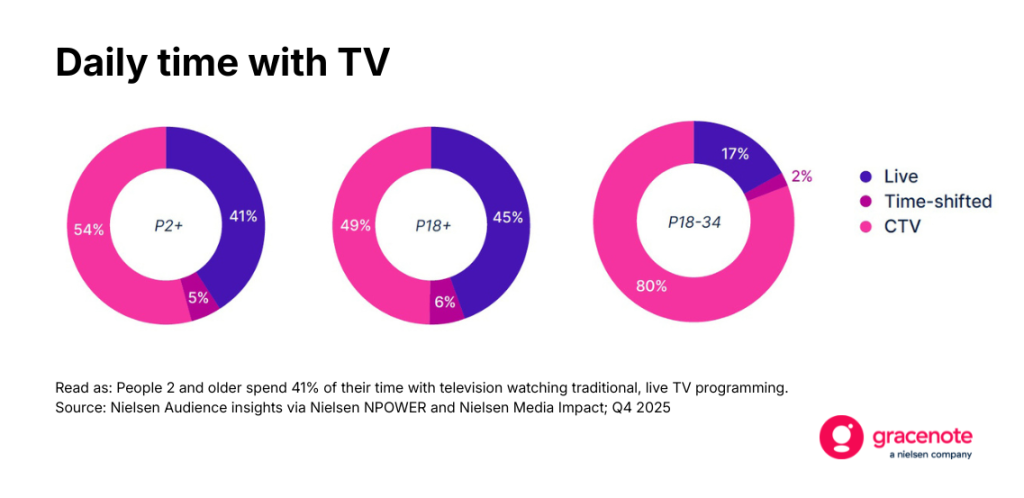
The shift to CTV use also has a significant impact on advertising—even across premium streaming services. Notably, ad-supported programming is now the norm, as 74% of all TV was ad-supported as of Q4 20254. The downside here, however, is that a significant portion of CTV inventory lacks the critical metadata needed to inform ad-buying decisions.

According to March 2026 research from contextual data company Peer39, only 40% contain usable program-level content signals. Within that 40%, however, data transparency is very limited: 33% has some genre data available and 7% has shallow or inaccurate genre data.
This lack of inventory transparency is a notable factor in CTV ad waste. In February 2026, research from Truthset found that marketers are wasting $7.4 billion in CTV advertising because of inaccurate data signals.
In the world of sports programming, basic genre information is helpful, but it typically isn’t enough to provide meaningful content transparency. Qualifiers like “live,” “team sport” and “playoffs” help distinguish a baseball game between the NY Yankees and the LA Dodgers from a sports program that features cricket game highlights and analysis.
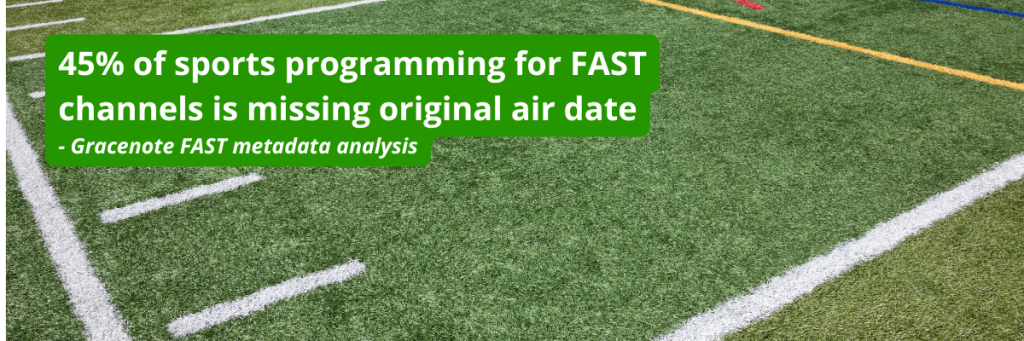
A recent Gracenote analysis of sports programming slated for distribution across FAST channels in the U.S. between January and March, for example, found that only 55% of the content included original air date information. Across global FAST channels, the percentage drops to 46%. Without this data, programmatic systems are unable to distinguish between live games and replays. Also noteworthy is that just under 58% of these programs (43% globally) included episode titles—additional information that provides valuable transparency into content inventory.
While foundational content metadata is critical in providing transparency into video attributes like production year, genre and content description, TV listing data provides an additional layer of data that provides even more granular information about specific programming. This information is extremely valuable for sports content, such as air date, competing teams, sport, league and playoff details. Here is the TV listing information for the Jan. 19, 2026, CFP Championship game between Miami and Indiana.
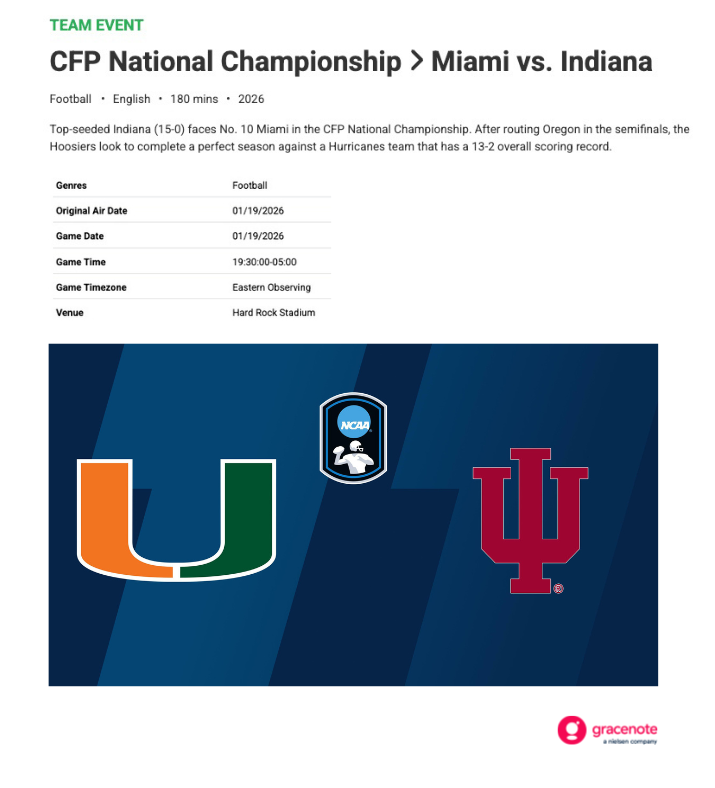
Given inventory transparency challenges, identifying specific sports events like the CFP Championship in the programmatic bidstream is challenging for brands and agencies. To capitalize on the opportunity that high-profile sports events like these present, brands are working with agencies that partner with CTV publishers, sell-side providers and contextual metadata companies to achieve the targeted precision they desire while maintaining optimal CPM efficiency.
For additional CTV advertising insights, download our 2026 CTV advertising report.
Notes
- Gracenote streaming and linear availability data
- Virtual multichannel video programming distributor
- Nielsen Audience insights via Nielsen NPOWER and Nielsen Media Impact; Q4 2025
- Nielsen’s The Gauge
The cost of fragmentation: Discovery challenges are pushing sports fans to highlights
Discovery is a bigger hurdle for sports fans than subscription cost.
Solving sports churn: the home screen advantage in modern streaming
Centralizing everything that fans are looking for can reduce churn and foster long-term engagement.
Home screen advantage
Centralized sports hubs could be game changing for content providers.